“I was fortunate to encounter acts of kindness and generosity that changed the course of my life. Mathematics then gave me a profession, a community, and a home. To borrow a phrase from a fictional footballer, Danny Rojas, “fútbol is life”. For many of us gathering here, mathematics is life. A source of beauty, friendship, purpose, and belonging.”
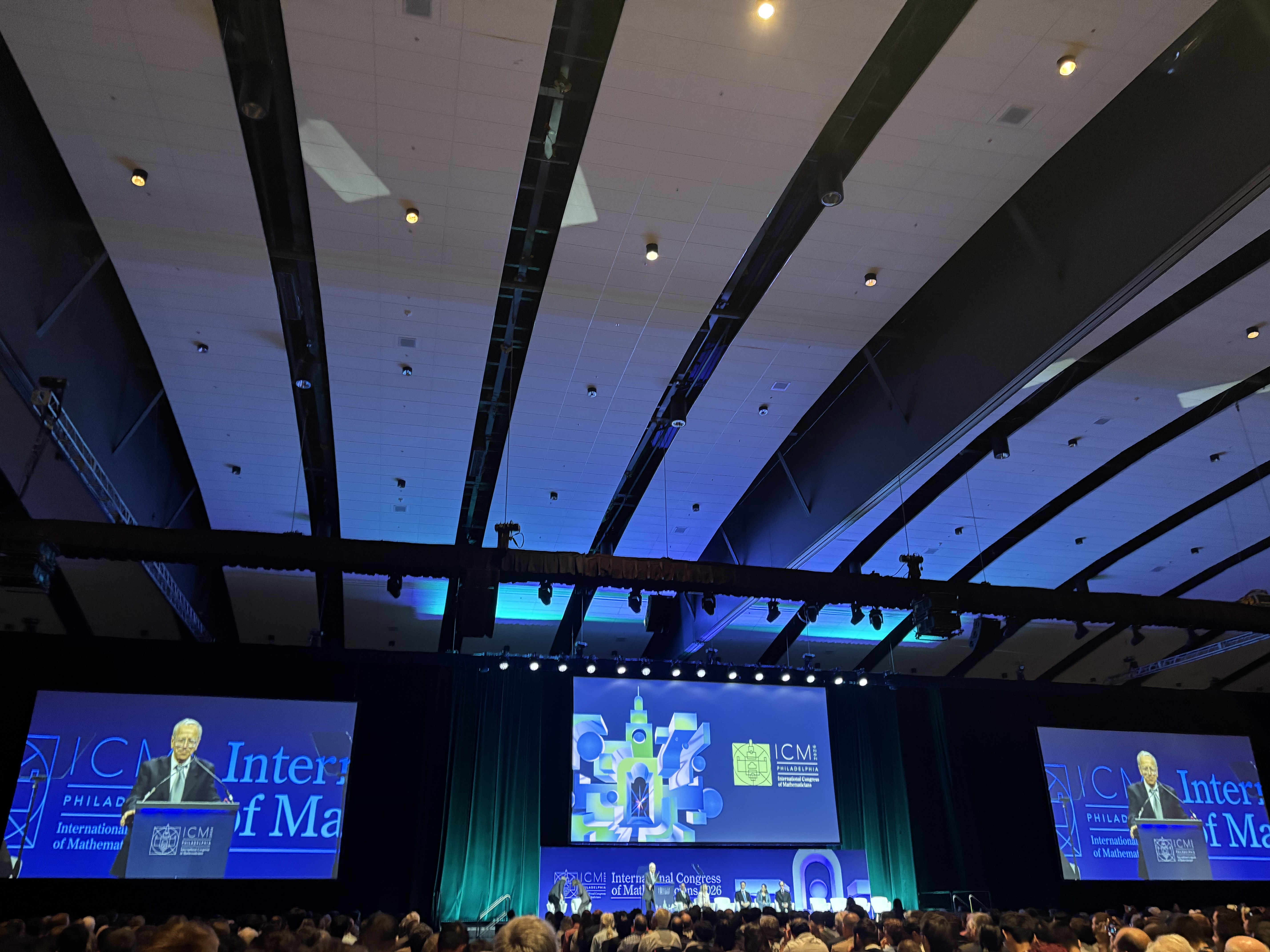
2026 ICM opening remarks by Jalal Shatah (pictured above, photo by me).
The 2026 International Congress of Mathematicians (ICM) took place in Philly earlier this summer — and amid less than ideal national and international circumstances, a situation that is not uncommon in the long history of the ICM.
The international and domestic crises notwithstanding, those who were able to make it to Philly were rewarded by an intensive and invigorating week of mathematics and community. More so, for people like me who have been following for the last 18 months or so the bleak political situation in the US, this gathering was a much needed reprieve, and a reminder that there is a world out there of people who cherish curiosity, honesty, hard work, and openness.
There were of course many wonderful talks in the various sections. This was my first ICM so I got to enjoy watching top quality talks in fields that were not my own and learn a thing or two. Of those section talks, I will only highlight Rachel Greenfeld’s, which was fantastic. Perhaps not coincidentally, it was a joint session talk for something like 7 different sections (her talk doesn’t seem to be available online yet; when it does I will update this with a link).
The looming crisis — or the looming je ne sais quoi.
Mathematicians have been subjected for the better part of a year to a narrative about a looming crisis for the field. A lot of this is driven by headlines and social media rumors and by occasional (with increasing frequency) announcements of LLM-generated solutions to open problems. This much was palpable in the Congress, both in the talks themselves but in the conversations between plenary and section talks, and at dinners every evening.
Talking face to face to dozens of mathematicians you know and trust and hearing about their thoughts on what is going on was invaluable. Coming into the congress I had been feeling a bit alone in my lack of worry (or rather in my exceeding optimism) / inability to cheer up colleagues worried about the future, but after the conversations and the talks I came back invigorated and reassured. There was a whole spectrum of perspectives / levels of concerns about AI and its impact on the mathematics profession, but the commonality was love for mathematics and a commitment to see its community continue to thrive. I did even utter a celebratory “we are so back!” a couple of times during the congress. In this regard I must highlight as especially relevant Terry Tao’s public plenary talk Mathematics in the age of AI, as well as the three panels related to artificial intelligence: mathematics for AI, AI for mathematics, and AI in college math education.
Now without minimizing the certain challenges the profession faces, the reason I am optimistic is not because I think there are not serious problems here (and ahead of us), but because the problems I feel we are facing are ones that are solvable and the challenges ahead are ones that mathematicians have it within themselves to meet and overcome. Terry did say it in his plenary talk (slide 5 in this PDF), while we are entering a turbulent period (not the first time this happens in math!) involving the foundational values of our profession, we have within us as a community to emerge stronger and more resilient than before. So what is looming might well be a new golden era for mathematics and science; we just need to have some courage as well as some faith (in mathematics and in ourselves). I will be writing more about this in the coming days (not entirely unrelated, please go check out the Palomar Registry!, I will write more about this too).
World Cups and ICMs every year, somehow?
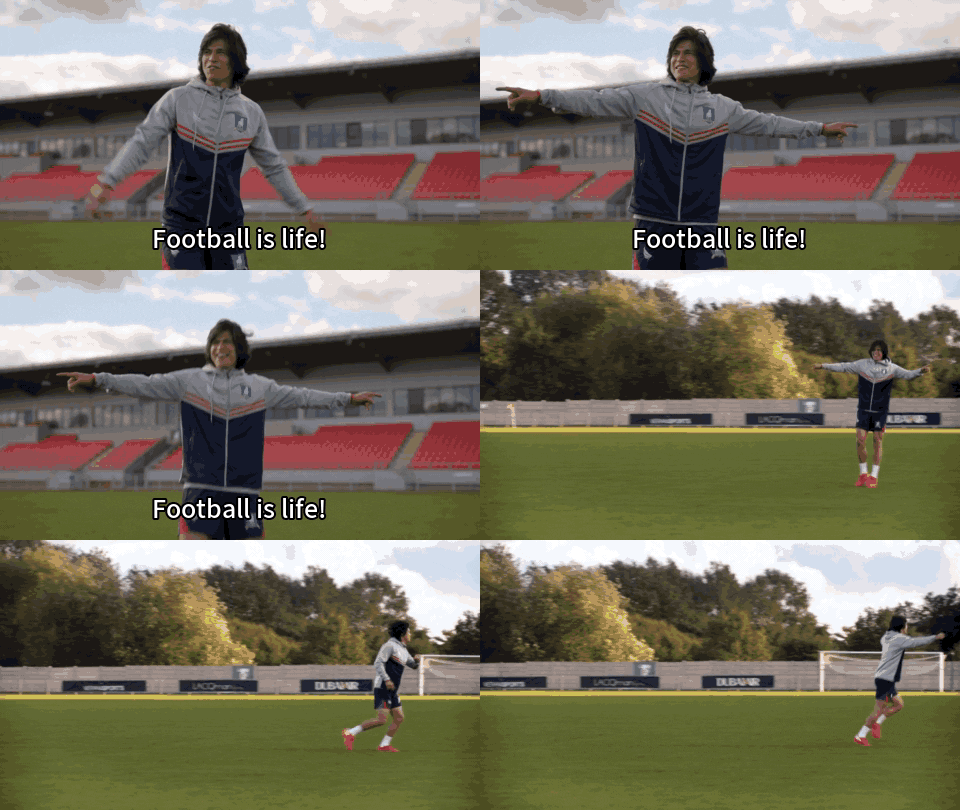
If you are reading this and need a morale boost I encourage you to attend a conference and spend time with more of your fellow mathematicians. Early this July I found myself wishing the same thing I always do at the end of the world cup: “wouldn’t it be nice if we actually did this every year?”, and with the end of the ICM in late July, I found myself thinking those same words again.
Now it is hard to match the scale and scope of an ICM, but a lot of the sense of community I felt this July I have also felt at the Joint Math Meetings. So maybe I should make a point of going to those more often. Even more similar to the ICM in its scope and depth is the International Congress of Basic Science, which I attended a few weeks ago and was also a wonderful experience, and unlike the ICM it happens every year (and I hope that this continues being so). This was a two week event covering all areas of mathematics, but also involved physics and engineering. As at the ICM, conversations between plenary talks and sections talks revolved a lot around AI and mathematics, and I found this to be a nice continuation of the experience at the ICM.
As a few friends have noted this summer, we are about to enter a critical period for the mathematics profession. The next year or two is a time where our decisions can do a lot to ensure the wellbeing of the mathematical community. I know that mathematics, at its very essence, will be fine: it is basic human nature to want to understand things. However far the new tools reach, there will be understanding to be done on top of what they do — the farther the tools go, the farther the point where our own understanding can and must go. To navigate this critical period, it is important more than before that we listen to as many people as possible and to reassess / remember / refound what mathematics values are, and for that we must lean into that source of beauty, friendship, purpose, and belonging Jalal talked about in his ICM opener. Math is life!